000356 – Copy

High vs. Low RTP in Online Casino Slots

When you first enter an online casino, the return-to-player percentage becomes a crucial factor in determining which slots might align best with your playing style. For additional perspective on these metrics, mino casino de may be useful. This metric, often abbreviated as RTP, provides a theoretical snapshot of how much money a specific game returns to players over a vast number of spins. While the flashing lights and thematic animations capture the immediate attention, the underlying mathematics dictates the long-term flow of funds between the player and the casino. For a new visitor, understanding this distinction is not merely academic; it is a practical step in choosing a game that offers the best statistical chance of a satisfying experience. You can explore specific mathematical models by visiting .

• High RTP slots are generally favored by players who prioritize consistency and want to stretch their bankroll over a longer period

•         These games typically offer a return percentage of 96% or higher, meaning that for every $100 wagered, the game is programmed to pay back approximately $96 over time

•         Choosing the right balance between these two types of slots is a personal decision that depends entirely on your goals

•         Both styles have their place within the diverse ecosystem of a casino, catering to different psychological needs and financial strategies

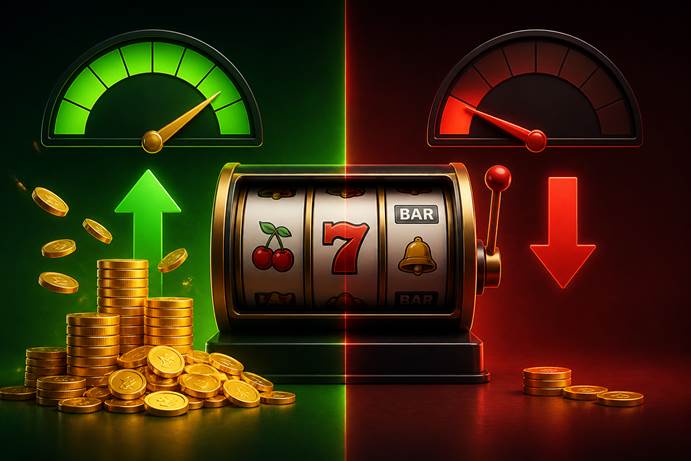
High RTP slots are generally favored by players who prioritize consistency and want to stretch their bankroll over a longer period. These games typically offer a return percentage of 96% or higher, meaning that for every $100 wagered, the game is programmed to pay back approximately $96 over time. In a competitive online casino, high-RTP titles often serve as the backbone of a player’s strategy because they reduce the volatility of the session. Players who frequent a casino looking for steady, smaller wins will find that high-RTP machines provide a more reliable flow of entertainment value per dollar spent. This approach transforms the act of gambling into a more measured form of risk management.

The Link Between Lower and Games

Conversely, low RTP slots usually present a different proposition, often featuring higher volatility to compensate for the lower percentage of returned funds. These games might only return 90% to 94% of wagers over time, but they are frequently the ones associated with massive jackpots and rare, life-changing payouts. In a busy casino, you will often see high rollers clustered around these machines, chasing the possibility of a massive single hit that offsets the statistical disadvantage. While the math suggests a lower probability of winning, the allure of the jackpot makes these low-RTP games incredibly popular among those willing to risk more for a chance at a larger reward.

Slot Design: Key Considerations

Choosing the right balance between these two types of slots is a personal decision that depends entirely on your goals. A player who visits a casino for an hour of relaxed fun might prefer a high-RTP game to ensure they have enough credits left to enjoy the experience. In contrast, a player with a larger bankroll and a higher tolerance for risk might opt for low-RTP slots, accepting the higher mathematical house edge for the thrill of the potential big win. Both styles have their place within the diverse ecosystem of a casino, catering to different psychological needs and financial strategies.
Area

What to know

Context

High RTP slots are generally favored by players who prioritize consistency and want to stretch their bankroll over a longer period.

Consideration

Conversely, low RTP slots usually present a different proposition, often featuring higher volatility to compensate for the lower percentage of returned funds.

Practical takeaway

Choosing the right balance between these two types of slots is a personal decision that depends entirely on your goals.

Why Player Experience Matters

Ultimately, viewing these percentages as indicators of long-term mathematical design rather than predictive tools transforms how players approach each session at their preferred casino. The most successful players are those who recognize that while the casino always holds the mathematical edge, understanding RTP allows them to minimize that edge over time. By selecting games that match their bankroll and temperament, players can ensure that their time spent at the casino remains a form of entertainment rather than a financial burden.

L’Importance de la Sécurité dans les Casinos en Ligne

La sécurité est un aspect crucial dans l’industrie des casinos en ligne, surtout avec l’augmentation des cyberattaques. En 2023, une étude de Cybersecurity Ventures a révélé que les pertes dues à la cybercriminalité dans le secteur du jeu pourraient atteindre 6 milliards de dollars d’ici 2025. Cela souligne l’importance pour les joueurs de choisir des plateformes sécurisées.

Un exemple de casino en ligne qui met l’accent sur la sécurité est le site Betway, qui utilise des technologies de cryptage avancées pour protéger les données des utilisateurs. Vous pouvez en apprendre davantage sur leurs mesures de sécurité sur leur site officiel. En 2022, Betway a été reconnu pour ses efforts en matière de sécurité par le Global Gaming Awards.

Les joueurs doivent également être conscients des licences des casinos. Un casino licencié est soumis à des réglementations strictes, ce qui garantit un environnement de jeu sûr. Pour plus d’informations sur les licences de jeu, consultez cet article sur The New York Times.

En outre, il est conseillé aux joueurs d’utiliser des méthodes de paiement sécurisées, telles que les portefeuilles électroniques ou les cartes de crédit, qui offrent une protection supplémentaire contre la fraude. Les casinos qui acceptent ces méthodes sont souvent plus fiables. Pour explorer des options de paiement sécurisées, visitez nouveau casino en ligne.

En conclusion, la sécurité dans les casinos en ligne ne doit pas être négligée. Les joueurs doivent faire preuve de diligence raisonnable en choisissant des plateformes sécurisées et licenciées pour garantir une expérience de jeu agréable et sans souci.

Canlı Casino Deneyimi: Geleceğin Eğlencesi

Canlı casino etkinlikleri , son senelerde kumarhane sektöründe yenilik yaratmıştır. 2023 yılında, Evolution Gaming, yeni bir canlı oyun tanıtarak sektörün liderliğini sağlamlaştırmıştır. Bu platform, oyunculara gerçek şans oyunları yöneticileriyle oyun oynama fırsatı sunarak, geleneksel kumarhanelerin atmosferini evlere getirmektedir. Evolution Gaming’in CEO’su Martin Carlesund, şirketin çağdaş çözümlerle sektördeki konumunu güçlendirdiğini vurgulamıştır. Martin’in projelerini daha yakından takip etmek için Twitter profilini ziyaret edebilirsiniz.

Canlı oyun oyunları, katılımcılar gerçek zamanlı bağlantı ve sosyal yaşantı sunmaktadır. Oyuncular, krupiyeler ile sohbet edebilir ve diğer oyuncularla etkileşimde yer alabilir. Bu vaziyet, online kumarhanelerin sunduğu deneyimi daha da zenginleştirmektedir. 2024 yılı itibarıyla, canlı casino pazarının 10 milyar dolar aşması beklenmektedir. Bu artış, oyuncuların evlerinden ayrılmadan kumarhane deneyimi yaşamalarına olanak tanımaktadır.

Canlı casino oyunları , genellikle 21, şans oyunu ve baccarat gibi klasik müsabakaları içermektedir. Bu oyunlar, yüksek nitelikli görüntü ve ses ile sunulmakta, oyunculara gerçek bir kumarhane tecrübesi yaşatmaktadır. Ancak, oyuncuların emniyetli ve lisanslı platformları tercih etmeleri önemlidir. Daha fazla veri için Wikipedia bağlantısını ziyaret edebilirsiniz.

Sonuç itibarıyla, canlı casino etkinlikleri, kumarhane sektöründe önemli bir yer. Oyuncular, bu yenilikçi platformlar sayesinde daha çok esneklik ve eğlenceye ulaşmaktadır. Ancak, her zaman dikkatli davranmak ve bütçelerini iyi yönetmek, sorumlu oyun oynamanın önemli bir bölümüdür. Daha fazla veri için matadorbet bahis adresini ziyaret edebilirsiniz.

Les Tendances Actuelles dans l’Industrie des Casinos

En 2024, l’industrie des casinos connaît une transformation significative, marquée par l’essor des jeux en ligne et des technologies innovantes. Selon un rapport de Statista, le marché mondial des jeux en ligne devrait atteindre 127 milliards de dollars d’ici 2027, avec une forte demande pour des expériences de jeu immersives.

Un acteur majeur de cette évolution est le groupe Evolution Gaming, reconnu pour ses jeux de casino en direct qui permettent aux joueurs d’interagir avec de véritables croupiers. Pour en savoir plus sur leurs offres, vous pouvez consulter leur site officiel. En 2023, Evolution a lancé une nouvelle plateforme qui intègre la réalité augmentée, offrant une expérience de jeu unique et engageante.

Les casinos terrestres ne sont pas en reste. À Las Vegas, le Bellagio a récemment rénové ses espaces de jeu pour inclure des technologies de pointe, telles que des tables de jeu interactives et des systèmes de reconnaissance faciale pour améliorer la sécurité. Ces innovations visent à attirer une clientèle plus jeune, avide de nouvelles expériences.

Pour les amateurs de paris sportifs, l’intégration des données en temps réel est devenue essentielle. Les plateformes de paris, comme DraftKings, utilisent des algorithmes avancés pour fournir des analyses précises et des conseils de paris. Pour des informations détaillées sur les paris sportifs, visitez New York Times.

Il est crucial pour les joueurs de rester informés des tendances actuelles et des réglementations en matière de jeux. Les casinos en ligne doivent être licenciés et respecter des normes de sécurité strictes. Pour explorer des options de jeux en ligne, consultez casino en ligne retrait instantané https://casino-enligne.pink/. En fin de compte, que vous soyez un joueur occasionnel ou un passionné, comprendre ces tendances peut vous aider à maximiser votre expérience de jeu.

Casino Oyunlarında Strateji ve Başarı İçin İpuçları

Casino rekabetleri, şans faktörü ve stratejinin kavuştuğu bir alemdir. başarılı bir oyuncu olmak için yalnızca talih itimat etmek kafi değildir; benzer zamanda hakkaniyetli yöntemleri de icra etmek gerekir. 2023 yılında yapılan bir çalışmaya göre, stratejik oyun oynama becerileri, katılımcıların başarma oranlarını %30 oranla çoğaltabilir.

Özellikle poker türü gibi strateji gerektiren müsabakalarda, rakiplerinizi değerlendirmek etmek ve doğru adımları yapmak önemli değere sahiptir. uzman poker oyuncu Daniel Negreanu, müsabaka içindeki duygusal bileşenleri kullanarak rakiplerini alt etme açısından uzmanlaşmıştır. Onun rekabet taktikleri hakkında daha fazla bilgi almak için Twitter profilini incelemek edebilirsiniz.

Casino rekabetlerde ilgi gösterilmesi gereken bir diğer değerli husus, finans planlamasıdır. katılımcılar, kayıplarını telafi etme hevesiyle daha fazla finans gider yapmak yerine, seçtikleri harcama planına sadık durmalıdır. Bu, geniş vadede daha devamlı bir müsabaka tecrübesi sağlar. Ayrıca, oyunların hükümlerini iyi bilmek, başarma ihtimalini artırır. Daha fazla veri için New York Times içeriğini inceleyebilirsiniz.

Online casinoların popülaritesi de giderek yükselmektedir. Bu sistemler, oyunculara ev konforlu oyun oynamak imkanı sunarken, çeşitli hediyeler ve teşvikler ile de ilgi çekmektedir. Ancak, sağlam bir ortam tercih etmek mühimdir. yetkili ve kontrol edilen platformlar, oyuncuların emniyetini sağlamak için gerekli önlemleri alır. emniyetli bir site bulmak için pin up casino bağlantısını ziyaret edebilirsiniz.

Sonuç olarak, kumarhane oyunlarında başarılı olmak için taktik, finans idaresi ve sağlam sistem seçimi gibi unsurlara ilgi göstermek gerekmektedir. Bu öğeleri göz karşısında bulundurarak, hem eğlenceli hem de kazançlı bir yaşantı tahammül etmek olasıdır.

How Online Casinos Use Automated KYC Technology

Many observers assume that manual review remains the primary method for validating user identities, yet most modern platforms have shifted toward high-speed digital processes to handle registration volume efficiently. For another perspective on this account-related point, casino en ligne france légal may be useful. Instead of relying on teams of administrators to pore over photocopied documents, many now depend on automated KYC technology to authenticate user data in real time. This technical transition is frequently mischaracterized as a reduction in security standards, when in reality, the move serves to minimize the human error that often plagues manual entry. By using machine learning to cross-reference submitted IDs against global databases, operators can achieve a level of consistency that a person working under a high-volume workload simply cannot sustain.

  • When a player uploads a photo of their passport or driver’s license, the software extracts the data points and matches them against reliable government or credit registries
  • A common misconception suggests that these automated systems operate in a vacuum, ignoring the nuanced behavioral patterns associated with different jurisdictions
  • A high-stakes wager or a suspicious withdrawal pattern can trigger a secondary layer of scrutiny that demands additional documentation, such as utility bills or bank statements
  • The algorithm does not simply grant or deny access based on a static checklist; it evaluates the incoming data against a set of dynamic rules that adapt to the shifting security
  • However, automated KYC technology is specifically designed to facilitate encryption and secure data handling that keeps sensitive documentation away from unnecessary human eyes
  • The information is hashed, verified, and stored according to strict protocols, ensuring that the verification step does not inadvertently become a security vulnerability for the participant

Account Access and Use

The core of this system involves optical character recognition and liveness detection, tools that go beyond simple image storage. Automated KYC technology examines the unique features of a government-issued identification card, checking for holographic patterns, specific fonts, and physical anomalies that indicate tampering. When a player uploads a photo of their passport or driver’s license, the software extracts the data points and matches them against reliable government or credit registries. This creates an immediate feedback loop, allowing the platform to flag inconsistencies in seconds. Rather than slowing down the user experience with lengthy waiting periods, these systems approve legitimate accounts almost instantly while isolating potentially fraudulent requests for further scrutiny.

A common misconception suggests that these automated systems operate in a vacuum, ignoring the nuanced behavioral patterns associated with different jurisdictions. In truth, the integration of automated KYC technology allows online casinos to customize their vetting depth based on the specific risk profile of a region or a transaction type. A high-stakes wager or a suspicious withdrawal pattern can trigger a secondary layer of scrutiny that demands additional documentation, such as utility bills or bank statements. The algorithm does not simply grant or deny access based on a static checklist; it evaluates the incoming data against a set of dynamic rules that adapt to the shifting security requirements of the current gaming environment.

Security and Risk

Critics occasionally argue that digital automation prioritizes data collection over player privacy, suggesting that personal information is handled with less care when processed by a machine. However, automated KYC technology is specifically designed to facilitate encryption and secure data handling that keeps sensitive documentation away from unnecessary human eyes. By stripping away manual access to physical document copies, the risk of data leaks stemming from employee misconduct or improper storage is significantly reduced. The information is hashed, verified, and stored according to strict protocols, ensuring that the verification step does not inadvertently become a security vulnerability for the participant.

Metrics and Performance

The effectiveness of this technology relies on the continuous updating of its underlying datasets. As synthetic media and deepfake techniques advance, online casinos must keep their verification engines agile enough to spot sophisticated digital forgeries. This involves testing the software against evolving patterns of identity theft and credential stuffing. The focus remains on accuracy and resilience, ensuring that the barrier to entry for genuine players remains low while the threshold for bad actors becomes increasingly difficult to cross. Ultimately, the industry is not just replacing manual labor but is instead building a more robust defense mechanism that keeps pace with the modern digital climate.

How European Roulette Works in Online Casinos

Understanding how European roulette works in online casinos begins with a single visual cue that many newcomers miss: the wheel carries just one green zero pocket alongside the numbers one through thirty-six. A related resource such as real money slots can help frame the discussion. That lone zero is the quiet architect of every calculation on the table, and it is the detail that separates this variant from its American cousin, which adds a second green pocket and tilts the odds further against the player. Recognizing this difference early helps frame everything that follows, and a quick comparison against a trusted reference such as can confirm whether the layout on your screen matches the rules you expect from a brick-and-mortar venue.

Wheel, Each, and the User Experience

The heart of the experience lies in how the software handles randomness, and here online casinos typically rely on a random number generator that resolves each spin the moment the button is pressed. The result is statistically indistinguishable from a real wheel over time, though some platforms offer live dealer variants where a physical croupier and wheel are streamed to your device. Each approach creates its own rhythm and atmosphere, but neither alters the underlying mathematics of the single-zero wheel, so the choice between them comes down to preference rather than fairness.

  • The result is statistically indistinguishable from a real wheel over time, though some platforms offer live dealer variants where a physical croupier and wheel are streamed to your device
  • Each approach creates its own rhythm and atmosphere, but neither alters the underlying mathematics of the single-zero wheel, so the choice between them comes down to preference rather than
  • The betting grid mirrors the traditional layout exactly, with inside bets covering single numbers or small clusters and outside bets stretching across dozens, columns, colors, and parity
  • No sequence of doubling bets or pattern tracking can overcome the mathematical reality that each spin stands alone and the wheel has no memory

The betting grid mirrors the traditional layout exactly, with inside bets covering single numbers or small clusters and outside bets stretching across dozens, columns, colors, and parity. Payouts remain fixed regardless of stake size, and the interface often adds features like automatic chip placement and history displays that help casual players track recent outcomes. These tools serve entertainment value rather than predictive power, and treating them as anything more than decorative flourish leads to frustration rather than insight.

Overcome, Accepting, and the User Experience

Accepting the built-in house edge as a cost of entertainment rather than a challenge to overcome keeps the experience grounded. No sequence of doubling bets or pattern tracking can overcome the mathematical reality that each spin stands alone and the wheel has no memory. Online play makes this truth easier to recognize by stripping away the distractions of crowds and casino noise, letting attention settle purely on the cadence of betting and spinning without pressure from onlookers.

How Spin Works

The appeal of European roulette in online casinos lies not in systems promising consistent wins but in the clean, fair tension of each spin. The single-zero wheel offers slightly better odds than other variants, and the polished digital presentation delivers the suspense of the original game to any device at any hour. Once the focus shifts from chasing losses to enjoying the measured excitement of the spin itself, the experience settles into something closer to its intended purpose.

How Credit Card Payments Work at Online Casinos

The familiar idea of “paying by card” suggests a direct transfer from the cardholder to the casino. That impression is misleading. A credit card payment is a set of messages exchanged among several businesses, followed by the movement of money through banking channels. The casino account balance, the card authorization, and the final settlement are related events, but they are not the same thing. Understanding those distinctions explains why a payment can appear successful yet remain pending, why a withdrawal may use another route, and why an issuer can refuse an otherwise valid transaction.

After a card is selected, its details are normally sent through an encrypted payment page or converted into a token that replaces the underlying card number. The casino, or its payment provider, then submits an authorization request containing the amount, currency, merchant identity, and transaction data. This request travels through a payment processor and acquiring bank to the relevant card network, which routes it to the issuing bank. The issuer checks the available credit, account status, billing information, legal restrictions, and automated risk signals. Its approval reserves part of the cardholder’s credit line; it does not immediately transfer that amount to the casino.

Approval is another point at which assumptions can cause confusion. An authorized transaction is a promise that the issuer will honor the charge if the merchant completes the process correctly. The merchant must later capture and settle the transaction, usually by submitting approved authorizations in a batch. Settlement moves funds through the card network, with fees and interchange costs deducted before the acquiring bank credits the merchant. Depending on the operator’s systems, casino funds may become visible before settlement finishes. A rejected or delayed settlement can therefore create a discrepancy between a card statement and the casino ledger, although legitimate operators normally reconcile such cases through their payment records.

The route is often simplified as a single line connecting the customer, bank, card network, and merchant, as in , but that shorthand conceals several separate responsibilities. Processors handle technical transmission, acquirers sponsor the merchant within the card system, networks set routing and operating rules, and issuers decide whether to approve individual charges. For additional context, sweet-bonanza can be considered alongside this overview. These roles may be combined by large financial firms, yet each function still exists. The merchant category code is particularly relevant because gambling transactions may receive different treatment from ordinary retail purchases, including issuer blocks, additional authentication, or cash-advance classification.

A decline does not necessarily mean the casino rejected the customer or detected wrongdoing. The issuer may be applying a policy on gambling-related purchases, responding to an exhausted credit limit, questioning an unusual location, or requesting stronger authentication. Many transactions use a system such as 3-D Secure, which can require a one-time code or confirmation through the issuer’s banking service. Successful authentication confirms that the person completing the transaction likely controls the card or associated device; it does not guarantee that the purchase is affordable, that the merchant is reputable, or that the issuer will accept every later charge.

Deposits and withdrawals also operate differently. A card deposit begins as an authorization and may end as a purchase or cash-advance-like transaction, depending on how the issuer classifies it. A withdrawal is not simply the original message sent backward. Some card systems permit refunds to the same card, often limited to the amount previously paid, while other payouts require a bank transfer or another supported method. Consequently, a pending casino withdrawal does not create a pending credit-card transaction. Its timing depends on the operator’s verification and processing procedures, while any eventual refund or payout follows separate financial rails.

Disputes are frequently mistaken for instant cancellations. Cardholders may challenge a genuinely unauthorized charge, but a chargeback is not designed to recover ordinary gambling losses or undo a purchase merely because its outcome was unfavorable. The issuer reviews the claim, the merchant can submit evidence such as account records and authentication results, and the card network may become involved if the parties disagree. Reversing a completed charge can also conflict with the casino’s terms and may lead to account restrictions. Fees, interest, currency conversion, and cash-advance treatment can further complicate the final cost. Recognizing the difference between authorization, settlement, merchant credit, payout, and dispute makes the system easier to assess without mistaking convenience for a direct or risk-free transfer.

Contrasting Ledger Architectures for Gaming Financial Systems

Deploying distributed ledger networks to manage funds for online entertainment platforms involves weighing structural contrasts among competing protocols. Traditional banking channels rely on centralized intermediaries, whereas decentralized networks operate on distributed consensus mechanisms. Operators examining this space frequently contrast legacy proof-of-work chains with newer proof-of-stake alternatives. Each model presents distinct implications for throughput, finality duration, and economic sustainability.

High-throughput networks facilitate rapid settlement times and minimal fees, making them attractive for microtransactions. Conversely, older, more established chains prioritize censorship resistance and deep cryptographic security over speed. When developers review structural trade-offs, they often rely on documentation provided by to understand how different consensus rules influence congestion patterns. High traffic volumes on certain platforms can trigger steep gas spikes, altering the cost predictability required for efficient payment routing.

Another major point of divergence lies in finality mechanics. Probabilistic finality systems carry a small window of vulnerability where a transaction might theoretically be reversed if an alternative chain branch grows longer. Deterministic finality approaches eliminate this uncertainty by requiring validators to reach immediate consensus on block validity. For financial ledgers supporting gaming platforms, deterministic finality offers stronger assurances against double-spending attempts, reducing the fraud risks associated with rapid asset transfers. For additional context, online casino ohne oasis sperre can be considered alongside this overview.

Interoperability features also shape architectural decisions. Bridges and cross-chain messaging protocols allow assets to move between disparate ecosystems, yet these bridges frequently introduce additional attack vectors. Native asset issuance on multi-asset ledgers simplifies accounting procedures compared to wrapped tokens that depend on external custodianship. Operators must weigh the convenience of broader token acceptance against the heightened security auditing requirements mandated by complex multi-chain architectures.

Regulatory considerations further complicate infrastructural alignment. Transparent public ledgers permit third-party auditors to verify transaction histories and trace funds, addressing certain anti-money laundering compliance requirements. However, complete transparency conflicts with consumer expectations regarding financial privacy. Privacy-focused protocols obscure transaction details, but this opacity can prevent platforms from meeting statutory reporting mandates in tightly regulated jurisdictions.

Ultimately, selecting an appropriate ledger depends on matching network capabilities with operational priorities. Whether an enterprise values absolute decentralization over processing speed or prioritizes low operational overhead above all else, understanding these technical trade-offs remains essential. A balanced infrastructure design prevents structural bottlenecks from disrupting user engagement, ensuring that financial transfers operate reliably within the bounds of prevailing technical and regulatory frameworks.

How Bingo Works at Online Casinos

Transitioning from paper cards and physical cages to browser windows has changed how participants experience bingo, even though the core rules remain largely familiar. For a related practical reference, pin up casino apk indir can complement these steps. If you want to check a reliable platform before buying tickets, you might review options via this to evaluate platform features. The transition relies on random number generation and automated verification systems that process hundreds of tickets simultaneously without human intervention.

Account Access and Use: Part 2

At the center of any digital bingo session is a computerized draw engine. Instead of a mechanical blower mixing wooden balls, a certified algorithm generates sequences of numbers at split-second intervals. When you purchase a virtual ticket, the system assigns a unique numerical grid to your account. As the software draws numbers, it instantly cross-references every active ticket on the server, removing the need for manual marking.

Area What to know
Context At the center of any digital bingo session is a computerized draw engine.
Consideration Most online casinos provide multiple variants of the classic format, with ninety-ball and seventy-five-ball setups being the most prevalent.
Practical takeaway Automation handles the tedious aspects of the pastime.

Most online casinos provide multiple variants of the classic format, with ninety-ball and seventy-five-ball setups being the most prevalent. Each style features its own structural layout and winning criteria. Ninety-ball layouts involve horizontal rows and three distinct tiers of prizes, rewarding players who hit a single line, two lines, or a full house. Seventy-five-ball variants typically utilize a grid featuring a blank center space and require participants to complete specific geometric shapes or letters to claim a payout.

Tools and Practical Use

Automation handles the tedious aspects of the pastime. Auto-daubing features mean the software automatically marks off numbers as they are called, ensuring that no potential win is ever missed due to slow reflexes. This allows participants to manage multiple cards across several concurrent rounds. Chat features integrated into the interface help preserve the communal atmosphere typical of physical establishments, letting participants converse with fellow players while automated systems run in the background.

  • At the center of any digital bingo session is a computerized draw engine
  • Instead of a mechanical blower mixing wooden balls, a certified algorithm generates sequences of numbers at split-second intervals
  • Most online casinos provide multiple variants of the classic format, with ninety-ball and seventy-five-ball setups being the most prevalent
  • Each style features its own structural layout and winning criteria
  • Seventy-five-ball variants typically utilize a grid featuring a blank center space and require participants to complete specific geometric shapes or letters to claim a payout
  • Automation handles the tedious aspects of the pastime
  • This allows participants to manage multiple cards across several concurrent rounds
  • Chat features integrated into the interface help preserve the communal atmosphere typical of physical establishments, letting participants converse with fellow players while automated

Account Access and Use

Financial accounting within these platforms runs through secure transaction gateways. Players deposit funds into an account balance, from which they purchase specific ticket allotments per round. Payouts for completed patterns credit instantly to the account ledger once the system verifies the win. Understanding this automated lifecycle ensures that players can approach online bingo with realistic expectations regarding odds, pacing, and house edges.