
High vs. Low RTP in Online Casino Slots
When you first enter an online casino, the return-to-player percentage becomes a crucial factor in determining which slots might align best with your playing style. For additional perspective on these metrics, mino casino de may be useful. This metric, often abbreviated as RTP, provides a theoretical snapshot of how much money a specific game returns to players over a vast number of spins. While the flashing lights and thematic animations capture the immediate attention, the underlying mathematics dictates the long-term flow of funds between the player and the casino. For a new visitor, understanding this distinction is not merely academic; it is a practical step in choosing a game that offers the best statistical chance of a satisfying experience. You can explore specific mathematical models by visiting .
• High RTP slots are generally favored by players who prioritize consistency and want to stretch their bankroll over a longer period
• These games typically offer a return percentage of 96% or higher, meaning that for every $100 wagered, the game is programmed to pay back approximately $96 over time
• Choosing the right balance between these two types of slots is a personal decision that depends entirely on your goals
• Both styles have their place within the diverse ecosystem of a casino, catering to different psychological needs and financial strategies
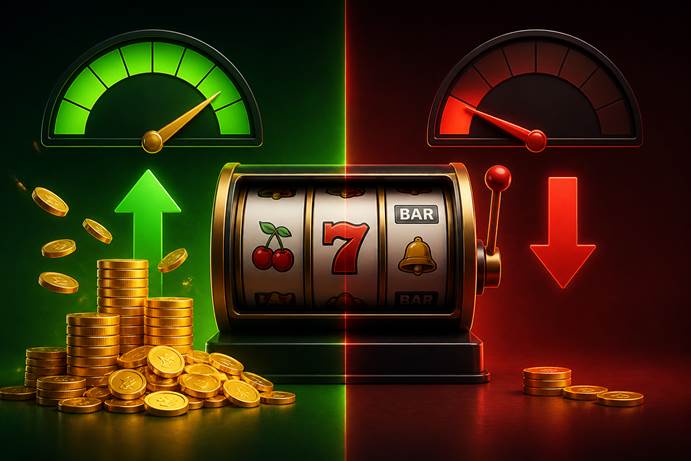
High RTP slots are generally favored by players who prioritize consistency and want to stretch their bankroll over a longer period. These games typically offer a return percentage of 96% or higher, meaning that for every $100 wagered, the game is programmed to pay back approximately $96 over time. In a competitive online casino, high-RTP titles often serve as the backbone of a player’s strategy because they reduce the volatility of the session. Players who frequent a casino looking for steady, smaller wins will find that high-RTP machines provide a more reliable flow of entertainment value per dollar spent. This approach transforms the act of gambling into a more measured form of risk management.
The Link Between Lower and Games
Conversely, low RTP slots usually present a different proposition, often featuring higher volatility to compensate for the lower percentage of returned funds. These games might only return 90% to 94% of wagers over time, but they are frequently the ones associated with massive jackpots and rare, life-changing payouts. In a busy casino, you will often see high rollers clustered around these machines, chasing the possibility of a massive single hit that offsets the statistical disadvantage. While the math suggests a lower probability of winning, the allure of the jackpot makes these low-RTP games incredibly popular among those willing to risk more for a chance at a larger reward.
Slot Design: Key Considerations
Choosing the right balance between these two types of slots is a personal decision that depends entirely on your goals. A player who visits a casino for an hour of relaxed fun might prefer a high-RTP game to ensure they have enough credits left to enjoy the experience. In contrast, a player with a larger bankroll and a higher tolerance for risk might opt for low-RTP slots, accepting the higher mathematical house edge for the thrill of the potential big win. Both styles have their place within the diverse ecosystem of a casino, catering to different psychological needs and financial strategies.
|
Area |
What to know |
|
Context |
High RTP slots are generally favored by players who prioritize consistency and want to stretch their bankroll over a longer period. |
|
Consideration |
Conversely, low RTP slots usually present a different proposition, often featuring higher volatility to compensate for the lower percentage of returned funds. |
|
Practical takeaway |
Choosing the right balance between these two types of slots is a personal decision that depends entirely on your goals. |
Why Player Experience Matters
Ultimately, viewing these percentages as indicators of long-term mathematical design rather than predictive tools transforms how players approach each session at their preferred casino. The most successful players are those who recognize that while the casino always holds the mathematical edge, understanding RTP allows them to minimize that edge over time. By selecting games that match their bankroll and temperament, players can ensure that their time spent at the casino remains a form of entertainment rather than a financial burden.